Lantus Starting Dose: How Your Doctor Calculates It
Learn how physicians calculate a Lantus starting dose using weight-based formulas and ADA guidelines, plus when 10 units is the right starting point.
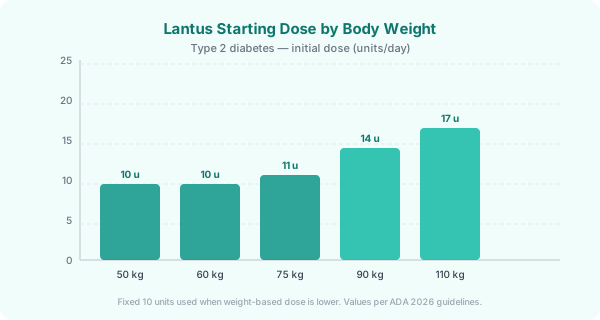
Your doctor just prescribed Lantus and wrote "10 units at bedtime" on the prescription pad. But where does that number come from? And why does your neighbor with the same diagnosis take 18 units?
The short answer is body weight and diabetes type, with a safety floor of 10 units. Here's exactly how physicians arrive at a starting Lantus dose, and how you can use our Lantus dosing calculator to understand the math behind your prescription.
The Two Starting Dose Approaches Physicians Use
The American Diabetes Association (ADA) Standards of Medical Care in Diabetes 2026 endorses two acceptable methods for initiating basal insulin in type 2 diabetes:
- Fixed-dose start: Begin at 10 units per day
- Weight-based start: Begin at 0.1–0.2 units per kilogram of body weight per day
Both approaches are valid. The choice depends on your weight, your doctor's preference, and how your clinic manages titration follow-up.
When the Fixed 10-Unit Start Makes Sense
For most patients under 70 kg, 10 units is essentially the same as the weight-based calculation. A 65 kg patient at 0.15 units/kg would receive 9.75 units, rounded to 10. The fixed start simplifies the prescription and reduces the chance of a math error at the pharmacy.
The other reason physicians choose 10 units: it's conservative. Starting insulin therapy always carries some hypoglycemia risk, and 10 units is low enough that the dose needs to be titrated upward, not immediately reduced. For patients new to injections who are anxious about low blood sugar, starting low and titrating up is often the right psychological approach as well as the pharmacologically sound one.
When Weight-Based Dosing Matters More
For patients over 90 kg, the 10-unit fixed start often provides insufficient coverage. A 100 kg patient at 0.15 units/kg should start at 15 units, and at 0.2 units/kg, that's 20 units. Beginning at just 10 units means weeks of sub-therapeutic dosing while titrating up, during which fasting glucose stays elevated and A1C doesn't improve.
The general formula your physician uses for type 2 diabetes: starting dose = max(10, 0.1 to 0.2 × body weight in kg). Our calculator uses 0.15 units/kg as the midpoint of this range, which aligns with the INSIGHT trial and other large RCTs evaluating basal insulin initiation.
Type 1 vs. Type 2: Why the Doses Differ
Type 1 diabetes requires higher basal insulin doses because there is essentially no endogenous insulin production. The pancreatic beta cells have been destroyed. Without any internal insulin, external Lantus must cover the body's entire basal glucose suppression needs.
For type 1 patients, the ADA and Endocrine Society recommend starting Lantus at 0.2–0.4 units/kg. A 75 kg person with type 1 diabetes would typically start at 15–30 units, with 18–19 units being a common midpoint. The full basal-bolus regimen for type 1 also requires rapid-acting insulin at meals, which covers an additional 40–60% of total daily insulin needs.
Type 2 patients who still produce endogenous insulin need less Lantus to reach the same glycemic targets. Their starting doses are lower, and they often plateau at a stable dose once fasting glucose is optimized, whereas type 1 patients may need more frequent adjustments as insulin sensitivity fluctuates.
Factors That Can Shift the Starting Dose
Your physician doesn't just plug your weight into a formula. Several clinical factors move the starting dose up or down:
Factors that push the dose higher:
- A1C above 9% (significant baseline hyperglycemia)
- Persistent fasting glucose above 200 mg/dL despite oral medications
- Patient has already failed to respond to maximum-dose oral diabetes agents
- High-dose corticosteroids causing significant glucose elevation
Factors that push the dose lower:
- History of hypoglycemia, particularly nocturnal episodes
- Renal impairment (CKD stage 3+), kidneys help clear insulin; impaired clearance prolongs effect
- Older age, especially frailty or cognitive impairment (can't recognize or treat hypoglycemia)
- Low BMI or recent significant weight loss
- Suspected Type 1 diabetes being re-evaluated (variable insulin sensitivity)
How Titration Gets You to the Right Dose
The starting dose is just a starting point, it's rarely the final dose. The real goal is to titrate until fasting blood glucose consistently falls in the 80–130 mg/dL target range set by ADA. Most patients reach their effective dose within 8–12 weeks of structured titration.
The most validated titration protocol, the "3-day rule", works like this: check your fasting glucose three mornings in a row. If the average is above 130 mg/dL and you haven't had any readings below 70 mg/dL, increase your Lantus by 2 units. Repeat every 3 days until you reach your target range.
Use our basal insulin titration calculator to estimate dose adjustments based on your current fasting readings. For a deeper look at titration mechanics, read our guide to the 3-day insulin titration rule.
What Happens If the Starting Dose Is Wrong?
Too low: Fasting glucose stays elevated. A1C doesn't improve. Patients sometimes abandon insulin therapy, concluding "it doesn't work," when the real problem was an inadequate dose that was never properly titrated. This is the most common scenario with a 10-unit fixed start in larger patients.
Too high: Early hypoglycemia, especially overnight. Patients on an aggressive weight-based start in the 0.3–0.4 units/kg range sometimes experience their first hypoglycemic episode within the first week. This is manageable with prompt education about hypoglycemia recognition, but it creates anxiety that can make patients reluctant to continue therapy.
The 3–7 day post-initiation follow-up call (standard at most endocrinology practices) exists precisely to catch these scenarios early.
Using the Calculator for Your Own Situation
Our Lantus dosing calculator asks for your body weight, diabetes type, and whether you're a new patient. For first-time basal insulin users, it outputs a starting dose with the same formula your physician uses, rounded to the nearest whole unit.
Keep in mind: the calculator gives you the textbook answer. Your physician's prescription reflects additional clinical context, your current medications, your comorbidities, your history with hypoglycemia, and dozens of other factors that a calculator can't know. Use this tool to understand your prescription, not to replace the conversation with your provider.
For patients already on Lantus, check our guide on Lantus dosing for type 2 diabetes to understand what the titration phase looks like month by month.