The 3-Day Rule for Insulin Titration: A Patient's Guide
The 3-day titration protocol is the evidence-based method for adjusting your Lantus dose. This guide explains how it works, why 3 days matters, and common mistakes to avoid.
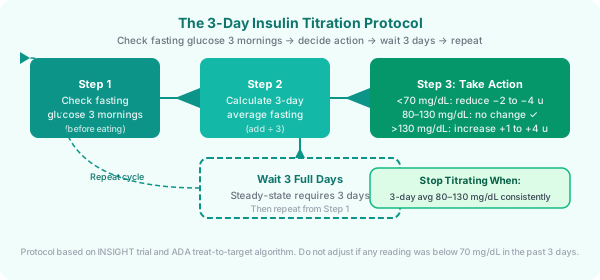
Most patients on Lantus know they're supposed to adjust their dose, but when to do it, how much to change, and how long to wait before changing again is often unclear. The 3-day titration protocol answers all three questions with a simple, evidence-based framework.
This isn't a rule invented to make things complicated. It's grounded in how long insulin glargine takes to reach steady-state in the body, a pharmacological reality that directly determines when a dose change will actually show up in your fasting glucose readings.
Why 3 Days?
Insulin glargine has a half-life of approximately 12 hours. After you change your dose, the new dose level takes about 3–4 half-lives (36–48 hours) to reach a new steady-state concentration in your bloodstream. Before that point, your fasting glucose readings are a mix of the old dose and the new dose, not a clean picture of whether the adjustment worked.
This is why the titration protocol requires a 3-day waiting period. You're not being patient for the sake of it, you're giving the pharmacology time to stabilize.
Patients who ignore this and adjust daily based on each morning's reading create a feedback loop that generates increasingly unstable glucose control. They overshoot in one direction, then overcompensate, then overcorrect again. The result looks like highly variable glucose on a continuous monitor, but it's entirely self-inflicted.
The Protocol Step by Step
1. Check your fasting glucose three mornings in a row. Fasting means first thing in the morning, before eating, drinking (coffee, juice), or taking any medication. Use the same meter each time if possible. Record all three values.
2. Review for hypoglycemia. Before calculating an average, look at each individual reading. If any single reading was below 70 mg/dL in the past 3 days, do not increase your dose. Do not average it away. A hypoglycemic reading is a safety signal that overrides the titration math.
3. Calculate your 3-day average. Add the three readings and divide by 3. This is the number that determines your next dose adjustment.
4. Apply the adjustment based on your average:
This table is consistent with the INSIGHT titration algorithm and the treat-to-target approach endorsed by both the American Diabetes Association and the Endocrine Society. Our Lantus dosing calculator applies these exact thresholds.
5. Wait 3 full days, then repeat. After making an adjustment, give your body 3 days to stabilize. Then run the 3-morning check again. Continue this cycle until your 3-day average is consistently in the 80–130 mg/dL range.
How Long Does Titration Take?
This depends on how far your starting dose is from your effective dose. A patient starting at 10 units with a fasting average of 195 mg/dL would increase by 4 units every 3 days:
- Day 1: 10 units → Avg 195 mg/dL → increase to 14 units
- Day 4: 14 units → Avg 168 mg/dL → increase to 16 units
- Day 7: 16 units → Avg 142 mg/dL → increase to 17 units
- Day 10: 17 units → Avg 118 mg/dL → no change (in target)
In this example, about 10 days of titration to reach an effective dose. Real titration often takes 3–6 weeks because fasting glucose fluctuates day to day and the adjustment steps slow as you approach the target range.
Common Mistakes
Mistake 1: Using a single reading instead of a 3-day average. One high morning reading after a large dinner the night before doesn't justify a dose increase. The 3-day average smooths out variability caused by meals, activity, and measurement error.
Mistake 2: Skipping the hypoglycemia safety check. Averaging in a 65 mg/dL reading with two normal readings produces a 3-day average that looks fine, say, 97 mg/dL. But the 65 is a signal that your dose was too high on that day. Always check each individual reading before computing the average.
Mistake 3: Increasing too fast because you're impatient. Some patients feel impatient and increase by 6–8 units at once, or titrate every day instead of every 3 days. This overshoots the effective dose, causes hypoglycemia, and then requires downward titration, a frustrating cycle that could have been avoided.
Mistake 4: Continuing to titrate when the dose is clearly too high. If you have multiple fasting readings below 80 mg/dL, stop. Reduce the dose. The target is 80–130, not "as low as possible."
Mistake 5: Stopping because the math seems complex. The titration protocol sounds technical when explained in full, but in practice it's: check 3 mornings, look at the numbers, add 2 units if still high, wait 3 days. Most patients master it in the first week.
Self-Titration vs. Supervised Titration
Self-titration using a structured protocol produces A1C results equivalent to physician-supervised titration in multiple randomized trials. The TITRATE study, the INSIGHT study, and the AT.LANTUS trial all support this. The key variable is patient education, patients who understand the protocol and have clear instructions achieve equivalent outcomes to those who call their physician for every adjustment.
That said, self-titration has limits. If your fasting glucose isn't improving after 3–4 weeks of consistent titration, or you're experiencing hypoglycemic episodes during titration, schedule a review with your care team. There may be other factors, meal timing, medication interactions, irregular sleep, that are sabotaging the protocol.
Use our Lantus dose calculator to enter your current dose and most recent fasting glucose, and get an immediate recommendation for your next adjustment. For an overview of what the full year of Lantus therapy looks like for type 2 diabetes, see our year-one Lantus guide.