Basal-Bolus Insulin Therapy: When Lantus Isn't Enough
Lantus controls fasting glucose, but some patients also need bolus insulin at meals. Learn how basal-bolus therapy works and what the signs are that you need it.
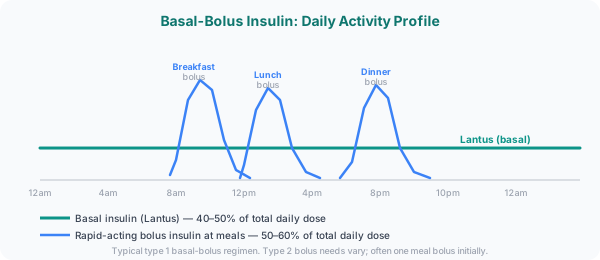
Lantus handles overnight glucose control well. What it doesn't do is cover the glucose that enters your bloodstream after you eat. For some patients, that's fine, their own insulin production handles post-meal glucose adequately, or other medications fill the gap. For others, the post-meal spike is where the A1C improvement stalls out. That's the signal that basal-only therapy isn't enough, and it's time to talk about basal-bolus therapy.
What Basal-Bolus Therapy Actually Means
A basal-bolus regimen uses two different types of insulin:
Basal insulin (Lantus/insulin glargine): Covers background glucose needs over 24 hours. Suppresses hepatic glucose output during fasting and between meals. Provides roughly 40–50% of total daily insulin for type 1 diabetes.
Bolus insulin (rapid-acting): Covers glucose from meals. Examples include lispro (Humalog), aspart (NovoLog), and glulisine (Apidra). These peak within 30–90 minutes and clear within 3–4 hours. They provide approximately 50–60% of total daily insulin for type 1 diabetes.
Every person with type 1 diabetes who uses multiple daily injections (MDI) is on a basal-bolus regimen. For type 2 diabetes, the need for bolus insulin varies, some patients manage well with basal insulin alone for years, while others need bolus coverage fairly quickly after starting Lantus.
The Signal: Fasting Glucose Is Good, But A1C Is Still High
The clearest indicator that Lantus alone isn't sufficient: your fasting glucose is now consistently in the target range (80–130 mg/dL), but your A1C at the 3-month check is still above 7.5–8%.
How is this possible? Because A1C reflects average glucose over the past 2–3 months, including the glucose spikes after every meal. If you eat three meals per day and glucose rises to 200–250 mg/dL after each one, those 2–4 hour post-meal peaks drag the average up significantly, even if your overnight fasting glucose is perfect.
Lantus does nothing about post-meal glucose. That's not a limitation, that's what it's designed to do. Basal insulin controls fasting glucose. Bolus insulin controls post-meal glucose. You need both to achieve full-day glycemic control in patients who can't produce enough of either.
Who Needs Bolus Insulin?
All type 1 patients: The pancreatic beta cells have been destroyed. There's no endogenous insulin to cover meals. Every type 1 patient on MDI uses a rapid-acting insulin at meals.
Type 2 patients with fasting glucose in range but high A1C: As described above, if basal is well-titrated and A1C is still elevated, post-meal spikes are the problem.
Type 2 patients with total daily insulin needs above 0.5 units/kg: Once Lantus doses exceed 40–50 units, some clinicians prefer splitting coverage with a meal-time bolus rather than continuing to increase basal. The reasoning: very high basal doses carry increased overnight hypoglycemia risk.
Type 2 patients after certain hospitalizations: Acute illness, surgery, or hospitalization with steroid administration can dramatically shift insulin requirements. Some patients emerge from the hospital on a temporary basal-bolus regimen that may become permanent.
Starting Bolus Insulin: The "Basal-Plus" Approach
Most endocrinologists don't start three bolus injections per day immediately. The common approach for type 2 patients transitioning to bolus insulin is basal-plus, adding one bolus injection at the largest meal of the day.
The starting bolus dose is typically 4 units before the main meal, then titrated using 2-hour post-meal glucose readings. The target 2-hour post-meal glucose is generally below 180 mg/dL.
This incremental approach makes the transition less overwhelming. Many patients who are anxious about adding a second injection find that one meal-time dose is manageable, and their A1C improvement is often dramatic enough to reinforce the change.
Calculating the Starting Bolus Dose
For type 2 patients with known total daily Lantus dose, a starting bolus can also be calculated as a fraction of that dose:
- Total daily bolus = approximately 50% of the current Lantus dose (as a rough starting estimate)
- Divide the total daily bolus by 3 meals
- Round to the nearest whole unit
For a patient on 30 units of Lantus: total bolus ≈ 15 units, divided by 3 = 5 units per meal. This is a starting point, individual meal composition and portion sizes require further titration.
For type 1 patients starting MDI from scratch, the calculation is more involved and requires counting carbohydrates and calculating an insulin-to-carb ratio. This is typically managed by an endocrinologist or diabetes educator.
Post-Meal Glucose Monitoring for Bolus Titration
When you add bolus insulin, the titration target shifts. Instead of just fasting glucose, you now monitor 2-hour post-meal glucose (measured 2 hours after the first bite of a meal). The target is below 180 mg/dL. Some clinicians use 140 mg/dL as a tighter target.
If your 2-hour post-meal glucose is consistently above 180 mg/dL, increase the bolus at that meal by 1–2 units. If it's below 80 mg/dL, reduce by 1–2 units. Don't adjust based on a single reading, use a 3-day pattern, similar to the basal titration approach.
Using the Lantus Calculator During Bolus Therapy
When you're on basal-bolus therapy, you still use the Lantus dosing calculator for your basal component. The fasting glucose drives your Lantus dose just as it did when you were on basal-only therapy. Don't let the addition of bolus insulin confuse the basal titration, keep the two titration processes separate.
Fasting glucose = Lantus dose signal.
2-hour post-meal glucose = bolus dose signal.
For more on what to expect from your A1C while on Lantus and Lantus + bolus therapy, see our guide on how Lantus affects your A1C. For a review of starting dose calculations for Lantus itself, see our starting dose guide.