How Lantus Affects Your A1C: Setting Realistic Expectations
How much can Lantus lower your A1C, and how fast? This guide explains the relationship between Lantus, fasting glucose, and A1C with realistic timelines from clinical trial data.
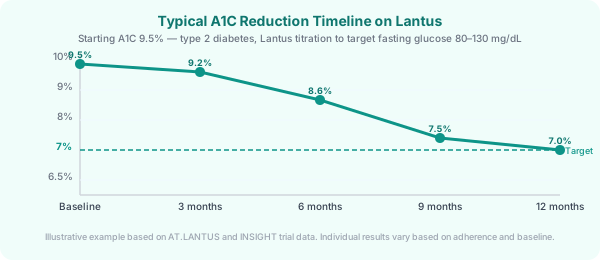
When your doctor starts you on Lantus, one of the first questions patients ask is: "How much will this lower my A1C?" It's a reasonable question, and the honest answer is: it depends, on your starting point, how consistently you titrate, and whether fasting glucose is the main driver of your elevated average.
Here's what the clinical evidence shows, and how to set expectations that are accurate rather than optimistic or unnecessarily discouraging.
What A1C Actually Measures
Hemoglobin A1C (HbA1c) measures the percentage of hemoglobin molecules in your blood that have glucose attached to them. Because red blood cells live about 2–3 months, A1C reflects average blood glucose over that window, not a single point in time.
An A1C of 7% corresponds roughly to an average glucose of about 154 mg/dL. An A1C of 9% corresponds to about 212 mg/dL average glucose. Each percentage point of A1C reduction corresponds to a reduction in average glucose of approximately 29 mg/dL.
For context: the ADA recommends a target A1C of below 7% for most non-pregnant adults with diabetes. The Endocrine Society and the American Association of Clinical Endocrinology (AACE) set slightly tighter targets for younger, healthier patients and slightly looser targets for older adults with significant comorbidities or high hypoglycemia risk.
How Lantus Specifically Affects A1C
Lantus reduces A1C primarily by lowering fasting glucose. Fasting glucose, the baseline glucose level before any meal, contributes approximately 30–40% of average daily glucose when A1C is above 8%. As A1C approaches normal range, the contribution of post-meal spikes increases proportionately.
This matters because it tells you exactly what Lantus can and can't achieve:
Lantus will lower your A1C if elevated fasting glucose is a significant contributor. For a patient with A1C of 9.5% and fasting glucose consistently above 190 mg/dL, bringing fasting glucose to 90 mg/dL through Lantus titration can reduce A1C by 1.5–2.5 percentage points over 6–12 months.
Lantus has limited A1C impact if post-meal spikes are the main driver. A patient with A1C of 8.2% but fasting glucose already in the 90–110 range is experiencing most of their glycemic burden from meals. Adjusting Lantus further won't help much, the right intervention is a bolus insulin or another post-meal agent.
What Clinical Trials Show
The AT.LANTUS trial enrolled over 4,900 patients with type 2 diabetes starting or switching to Lantus. At 24 weeks, patients who self-titrated using a structured algorithm achieved an average A1C reduction of approximately 1.5 percentage points (from ~8.7% to ~7.2%). About 40% reached the target A1C below 7%.
The ORIGIN trial (over 12,000 patients followed for median 6.2 years) showed that Lantus titrated to fasting glucose below 95 mg/dL achieved long-term A1C of approximately 6.5%, near-normal glucose, with a low rate of cardiovascular events and no increase in cancer risk.
For type 1 diabetes, the LANTUS Compared with Ultralente (LANMET) study and multiple other trials showed A1C reductions of 0.8–1.3 percentage points when Lantus replaced NPH insulin in MDI regimens, primarily due to fewer hypoglycemic episodes allowing for more aggressive fasting glucose targets.
Realistic A1C Timelines
A1C changes slowly, more slowly than fasting glucose. Because red blood cells take 2–3 months to turn over, a major dose adjustment won't show up in your A1C for 6–8 weeks. Here's what a typical trajectory looks like for a type 2 patient starting at A1C 9.5%:
- Months 1–3: Fasting glucose improving during titration. A1C may not yet show significant change, or may show a modest drop to 9.0–9.2%.
- Months 3–6: Dose stabilizes near the effective level. Fasting glucose consistently in range. A1C begins dropping more noticeably, often reaching 8.0–8.5%.
- Months 6–9: Continued improvement as months of controlled fasting glucose accumulate in the A1C average. Most patients see 7.5–8.0% at this point.
- Month 12 and beyond: Patients on well-titrated Lantus with good adherence typically reach 7.0–7.5%. Some reach below 7%.
Patients who never reach the fasting glucose target (80–130 mg/dL) during titration will have proportionally slower and smaller A1C improvements.
When A1C Doesn't Improve as Expected
If your A1C at 3 months hasn't improved despite consistent Lantus titration, several factors are worth evaluating:
Are you actually reaching the fasting glucose target? Review your glucose log. If readings are consistently above 130 mg/dL despite dose increases, the dose may not be high enough, or the titration protocol may not be being followed correctly. Use our Lantus dosing calculator to review whether your current dose aligns with your fasting glucose readings.
Are post-meal spikes masking the benefit? Check 2-hour post-meal glucose readings. If those are above 200 mg/dL regularly, you need additional treatment for post-meal glucose, not more Lantus.
Are other factors elevating glucose? Corticosteroids, antipsychotic medications, significant emotional stress, poor sleep, and infections can all raise glucose substantially and blunt the A1C response to insulin.
Are you missing doses? A missed Lantus dose every few days is enough to significantly blunt A1C progress. Consistency is not optional, it's pharmacologically necessary given Lantus's reliance on steady-state levels.
The A1C Floor on Basal-Only Therapy
For many type 2 patients, there's a practical A1C floor below which basal-only Lantus therapy can't take you, typically somewhere around 7.5–8.0%. Once fasting glucose is well-controlled, post-meal spikes dominate the remaining glycemic burden. If your A1C has plateaued above 7.5% despite excellent fasting glucose control, discuss adding a GLP-1 receptor agonist, an SGLT-2 inhibitor, or bolus insulin with your physician.
Read our guide on basal-bolus therapy to understand what the next step looks like and how it interacts with your Lantus regimen. For a comparison of Lantus and its biosimilar that may affect which product your insurance covers, see our Lantus vs. Basaglar guide.