Lantus vs Basaglar: Are They Really the Same Insulin?
Lantus and Basaglar both contain insulin glargine, but they differ in price, regulatory status, and switching rules. Here's what patients and providers need to know.
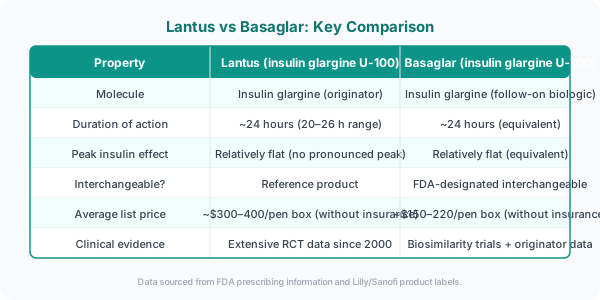
If your pharmacy just switched you from Lantus to Basaglar, or your insurer is pushing you to make the switch, you're probably wondering: are these really the same drug? The short answer is yes, mostly. But the details matter, especially when you're managing a chronic disease where small differences in insulin absorption can shift your glucose levels meaningfully.
What Makes Them the Same
Both Lantus and Basaglar contain insulin glargine, a long-acting insulin analogue manufactured by modifying the amino acid structure of human insulin. Both are formulated at U-100 concentration (100 units per milliliter), both are injected subcutaneously once daily, and both produce a relatively flat insulin profile over approximately 20–26 hours with no pronounced peak.
The FDA reviewed Basaglar's biosimilarity data and concluded that it has "no clinically meaningful differences" from Lantus in terms of safety, purity, and potency. That's about as close to "identical" as you'll get with a biologic molecule, which, unlike small-molecule drugs, can't be copied at the atomic level. Biologics are grown in living cells and can never be exact molecular replicas of each other.
For the purposes of dosing, the practical answer is: you use the same Lantus dosing formula for Basaglar. The dose your physician calculated for Lantus translates directly to Basaglar without adjustment.
The Key Difference: Price
This is where the distinction matters most for most patients. Basaglar was approved by the FDA in 2015 as a "follow-on biologic" to Lantus, with Eli Lilly pricing it roughly 15–20% below Lantus at launch. Since then, the price gap has widened. Patients without insurance or with high-deductible plans often pay significantly less for Basaglar out of pocket.
If you're paying full price at a pharmacy counter, the difference can be substantial, often $100–200 per month. For a medication you take every day indefinitely, that adds up.
Manufacturer savings programs also differ. Sanofi (maker of Lantus) offers the Insulins Valyou Savings Program; Lilly (maker of Basaglar) offers its own insulin assistance. The fine print on these programs changes regularly, so check current terms directly with the manufacturers.
Interchangeability: What "FDA-Designated Interchangeable" Actually Means
In 2021, the FDA designated Basaglar as an interchangeable biosimilar to Lantus. This specific designation means a pharmacist can substitute Basaglar for Lantus (or vice versa) without contacting the prescribing physician, the same way a pharmacist can dispense a generic metformin when a brand-name prescription is written.
This is clinically important: it means some pharmacies and insurance plans will automatically dispense Basaglar when Lantus is prescribed, unless the prescription explicitly states "dispense as written" (DAW). If you have a preference for one over the other, tell your physician to add DAW to the prescription.
A few states have additional regulations around biosimilar substitution, your pharmacist should know the rules in your state.
Clinical Evidence Comparison
Lantus has been available since 2000 and has an enormous body of randomized controlled trial data, including landmark trials like ORIGIN (which enrolled over 12,000 participants and followed them for more than 6 years). This long track record is meaningful: it tells us a lot about outcomes in diverse patient populations, including cardiovascular risk, cancer, and long-term safety.
Basaglar's approval was based on biosimilarity studies showing pharmacokinetic and pharmacodynamic equivalence to Lantus, plus clinical trials establishing equivalent glycemic control and safety. It doesn't have 25 years of post-marketing surveillance data yet, but this is true of every biosimilar relative to its reference product.
For typical patients managing type 1 or type 2 diabetes, this difference in evidence depth isn't clinically meaningful. Both insulins work the same way. The concern about long-term differences is more relevant for oncology biologics than for insulin.
Can You Switch Between Them?
Yes, and many patients do so successfully without any dose change. The FDA's interchangeability designation explicitly supports this. Most endocrinologists and diabetes educators will tell you: if your insurance switches you and your glucose control is stable, stay the course. Check your fasting glucose for a week or two after the switch to confirm your numbers haven't shifted.
If your fasting glucose increases after switching, it's more likely due to lifestyle changes, illness, or other medications than the insulin itself, but it's worth flagging with your provider.
Our Lantus dosing calculator applies equally to both products. Enter your current dose of either insulin glargine product and it will apply the same treat-to-target titration algorithm. For a review of how fasting glucose targets drive titration decisions, see our guide on fasting blood glucose targets on basal insulin.
What About Toujeo and Other Long-Acting Insulins?
Toujeo (insulin glargine U-300) is also made by Sanofi but is not the same as Lantus. It's a higher-concentration version (300 units/mL vs. 100 units/mL) that has a somewhat longer and flatter profile than Lantus. It's not interchangeable with Lantus on a unit-for-unit basis. Transitioning from Lantus U-100 to Toujeo U-300 typically requires a dose adjustment, usually 80% of the Lantus dose to start.
Tresiba (insulin degludec) is a different molecule entirely and is not interchangeable with insulin glargine. It has an even longer duration of action (>42 hours) and different dosing flexibility.
The Bottom Line
Lantus and Basaglar are therapeutically equivalent for the vast majority of patients. The dose is the same, the injection technique is the same, the side effect profile is the same. The main reason to choose one over the other comes down to cost and what your insurance covers. If you're switched from one to the other and notice any change in your glucose control, contact your diabetes care team, but don't assume the insulin is at fault without checking other variables first.