How to Store Lantus at Home and While Traveling
Lantus has strict temperature requirements that most patients don't fully know. Learn proper storage rules for home, travel, and extreme climates.
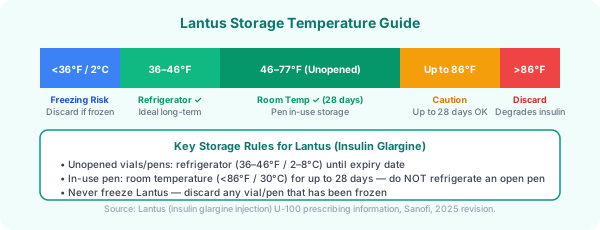
Lantus that has been stored incorrectly doesn't always look different. The vial won't have a warning label. The insulin won't smell off. But degraded insulin glargine can lose potency, which means unpredictable glucose control, sometimes for days before you figure out what happened.
Getting storage right is straightforward once you know the rules. Here they are.
The Two Storage Rules Most Patients Miss
The Lantus prescribing information (and every package insert since its original approval) contains storage instructions that are often oversimplified when relayed to patients. Here are the two that cause the most problems:
Rule 1: An opened (in-use) pen or vial should NOT be kept in the refrigerator.
This surprises most patients. The logic: repeatedly moving insulin between refrigerator and room temperature causes condensation inside the pen and can introduce air bubbles that affect dose accuracy. More importantly, cold insulin is more viscous, it can cause injection discomfort and slower, uneven absorption through the subcutaneous tissue.
Once you start using a pen or vial, keep it at room temperature (below 86°F / 30°C). It's stable for 28 days this way.
Rule 2: If Lantus freezes, discard it, no exceptions.
Freezing disrupts the glargine crystals that give the insulin its prolonged action profile. Frozen-then-thawed Lantus may look completely clear and normal but will absorb unpredictably. Patients who unknowingly use frozen insulin often experience sudden hyperglycemia and can't understand why their usual dose isn't working.
Keep Lantus away from the back of the refrigerator (where ice can form), away from car trunks in winter, and away from the freezer section of insulated bags.
Home Storage: Practical Setup
Unopened stock: Store in the refrigerator between 36–46°F (2–8°C). Use before the expiry date printed on the label.
Current pen (in use): Store at room temperature, on a shelf, in a medicine cabinet, or in a drawer away from direct sunlight. Avoid bathrooms (temperature and humidity fluctuations), windowsills (sun exposure), and anywhere near heat sources.
Mark the start date on your pen with a small sticker or permanent marker. After 28 days, replace it regardless of how much insulin is left, degradation is cumulative even if not visibly apparent.
Traveling Domestically
For travel within the same climate, the main concerns are:
- Car travel in summer: The interior of a parked car can reach 130–150°F (54–65°C) on hot days. Never leave insulin in a glove compartment or on a seat. Use an insulated case if you're traveling with your kit.
- Airport security: TSA allows insulin pens and vials in carry-on bags without special screening in most cases. Keep insulin and supplies in a clear bag for easy inspection. Carry a copy of your prescription.
- Changing time zones: Your dosing schedule is tied to clock time, not meal time per se. For short trips (1–2 time zones), most patients just adjust their injection time gradually. For longer shifts, your diabetes team can help you plan the transition.
Traveling Internationally
International travel with Lantus requires more planning:
Carry-on, always. Checked baggage can be exposed to extreme cold in cargo holds (temperatures can drop below −20°F / −29°C). Always keep insulin in your carry-on bag. This is both the temperature-safe option and the theft/loss-safe option, losing your insulin to lost luggage in a foreign country is a genuine medical emergency.
Volume for the trip, plus 50%. Bring 50% more insulin than you think you'll need. Delays happen. Pharmacies in other countries may not stock insulin glargine. The formulations available abroad may differ in concentration (U-100 vs. U-300) or pen system.
Cold chain during long travel: For trips longer than 48 hours in warm climates, a FRIO insulin wallet (an evaporative cooling pouch that needs only water to activate) can keep insulin within the safe temperature range without refrigeration. These are widely available and TSA-friendly.
Documentation: Carry a letter from your physician describing your diagnosis, insulin requirement, and medical equipment. This is helpful at customs checkpoints and essential if you need medical care abroad.
Hot Climates: Special Considerations
Tropical destinations, summer camping, and outdoor activities in heat require extra vigilance. Direct sunlight can heat insulin above the safe threshold even without ambient temperature being particularly high.
Signs that Lantus may have been heat-damaged:
- Cloudiness or unusual particles in what should be a clear solution (insulin glargine should always be clear and colorless)
- Unexpected hyperglycemia at a dose that usually works well
- Unexplained glucose variability over several days after potential heat exposure
When in doubt, replace the vial or pen. The cost of a new pen is trivial compared to the clinical consequences of using degraded insulin.
Insulin Cases and Accessories
Several well-designed insulin carrying cases maintain safe temperatures for 8–12 hours without active cooling. FRIO, Medicool, and similar products are popular among patients who travel frequently. If you're using a case with ice packs, wrap the ice pack to prevent direct contact with the insulin vial, freezing the outer surface while the center stays liquid can still damage the insulin.
Keep a backup pen at a separate location when possible, at work, with a family member, or in a carry-on bag if your main supply is elsewhere.
What to Do If You Suspect Damaged Insulin
If you think your Lantus may have been compromised, by heat, freezing, or prolonged storage beyond 28 days, don't use it. If you have a backup supply, switch to it immediately. If you don't, contact your pharmacy or physician. Many pharmacies can provide an emergency supply within hours with a prescription call-in.
Unexplained glucose elevations on a stable dose are worth a conversation with your care team. One of the first questions they'll ask: has anything changed about your insulin storage recently?
Our Lantus dosing calculator can help you check whether your current dose is appropriate if you're restarting with a new pen after a storage issue. For guidance on recognizing and treating low blood sugar, which is a risk any time you're changing your insulin situation, see our hypoglycemia prevention guide.